Vasopressors
Vasopressors
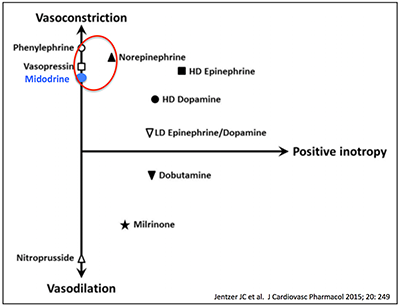
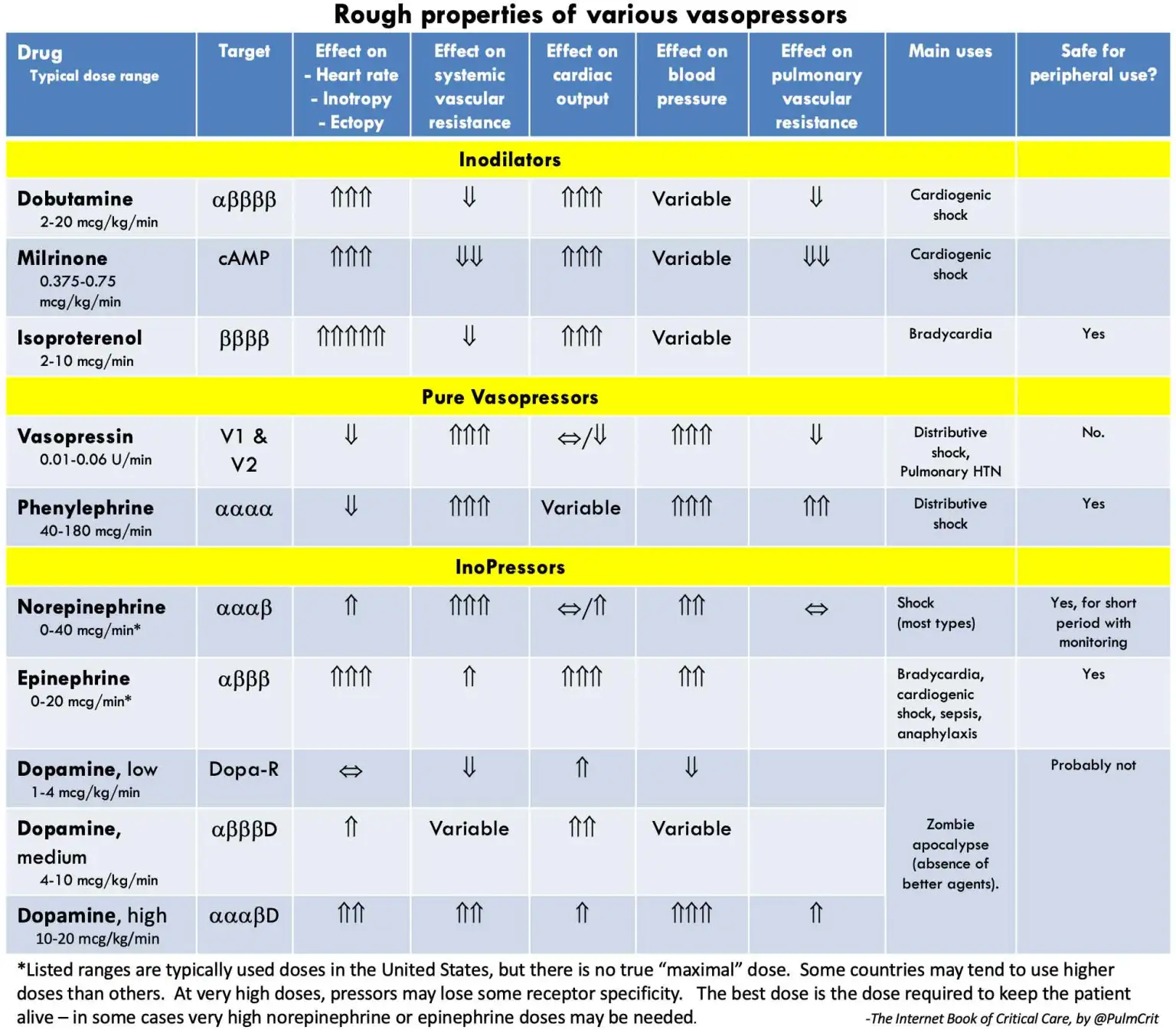
Infusion Dosing
Usual adult starting doses and titration ranges for continuous intravenous infusion. Doses are weight-based unless noted. Titrate to a target mean arterial pressure, not to a fixed dose. All doses below are for adults; pediatric and neonatal vasopressor management requires separate, age-specific guidance.
| Medication | Usual Dose Range |
|---|---|
| Norepinephrine | 0.01–3 mcg/kg/min SSC 2021SSC 2021 Sepsis and Septic Shock · 2021 · Crit Care MedInternational guidelines recommending norepinephrine as first-line vasopressor in septic shock, with vasopressin or epinephrine as second-line agents.View source ↗ |
| Epinephrine | 0.01–1 mcg/kg/min Jentzer 2021Jentzer 2021 Vasopressor and Inotrope Therapy · 2021 · J Intensive Care MedReview of vasopressor and inotrope selection in cardiac critical care; norepinephrine is first-line, dobutamine added for inotropic support, epinephrine and phenylephrine as alternatives.View source ↗ |
| Dopamine | 2–20 mcg/kg/min SOAP IISOAP II · 2010 · N Engl J MedNo overall mortality difference between dopamine and norepinephrine in shock; dopamine caused more arrhythmias.View source ↗ |
| β1-predominant: 5–10 mcg/kg/min | |
| β1 + α: > 10 mcg/kg/min | |
| Phenylephrine | 0.5–4 mcg/kg/min Jentzer 2021Jentzer 2021 Vasopressor and Inotrope Therapy · 2021 · J Intensive Care MedReview of vasopressor and inotrope selection in cardiac critical care; norepinephrine is first-line, dobutamine added for inotropic support, epinephrine and phenylephrine as alternatives.View source ↗ |
| Vasopressin | 0.03–0.04 units/min (fixed dose, not weight-based) SSC 2021SSC 2021 Sepsis and Septic Shock · 2021 · Crit Care MedInternational guidelines recommending norepinephrine as first-line vasopressor in septic shock, with vasopressin or epinephrine as second-line agents.View source ↗ |
| Dobutamine | 2–20 mcg/kg/min Jentzer 2021Jentzer 2021 Vasopressor and Inotrope Therapy · 2021 · J Intensive Care MedReview of vasopressor and inotrope selection in cardiac critical care; norepinephrine is first-line, dobutamine added for inotropic support, epinephrine and phenylephrine as alternatives.View source ↗ |
Norepinephrine is the recommended first-line vasopressor for most forms of shock SSC 2021SSC 2021 Sepsis and Septic Shock · 2021 · Crit Care MedInternational guidelines recommending norepinephrine as first-line vasopressor in septic shock, with vasopressin or epinephrine as second-line agents.View source ↗. Vasopressin (up to 0.03 units/min) may be added to reduce norepinephrine requirements in septic shock, rather than titrating norepinephrine to very high doses alone SSC 2021SSC 2021 Sepsis and Septic Shock · 2021 · Crit Care MedInternational guidelines recommending norepinephrine as first-line vasopressor in septic shock, with vasopressin or epinephrine as second-line agents.View source ↗. Dopamine is associated with more arrhythmias than norepinephrine and is no longer a first-line agent SOAP IISOAP II · 2010 · N Engl J MedNo overall mortality difference between dopamine and norepinephrine in shock; dopamine caused more arrhythmias.View source ↗.
Push-Dose Pressors (High-Alert)
Push-dose (bolus) vasopressors are used in emergency and critical-care resuscitation for temporary hemodynamic support while definitive therapy is established. These are high-alert medications. A single-center observational study of 105 push-dose pressor administrations found a 39% adverse hemodynamic event rate and a 19% human-error rate, with overdoses ranging from 2.5-fold to 100-fold the intended dose Cole 2019Cole 2019 Push-Dose Pressor Errors · 2019 · J Med ToxicolSingle-center study finding 39% adverse hemodynamic events and 19% human-error rate with push-dose pressors in the ED, including 2.5- to 100-fold overdoses.View source ↗. Only one dosing error occurred when a pharmacist was present.
This page does not provide bedside compounding or dilution instructions. Preparation of push-dose pressors requires a formally reviewed institutional medication-safety protocol that addresses:
- Standardized, pre-prepared concentrations (pharmacy-prepared when possible)
- Independent double-check of drug, concentration, and dose before administration
- Labeled syringes with drug name, concentration, and beyond-use date
- Clear documentation of each dose administered
- Continuous hemodynamic monitoring during and after administration
Clinicians who use push-dose pressors should follow their institution’s approved protocol. In the absence of an institutional protocol, the risks described by Cole et al. warrant extreme caution and a formal safety review before implementing bedside preparation.
Never administer a full cardiac-arrest dose of epinephrine (1 mg, 1:1,000) to a patient with a pulse. Push-dose epinephrine for patients with a pulse Cole 2019Cole 2019 Push-Dose Pressor Errors · 2019 · J Med ToxicolSingle-center study finding 39% adverse hemodynamic events and 19% human-error rate with push-dose pressors in the ED, including 2.5- to 100-fold overdoses.View source ↗. requires a diluted concentration (e.g., 10 mcg/mL or 100 mcg/mL) prepared under Weingart 2015Weingart 2015 Push-Dose Pressors · 2015 · Clin Exp Emerg MedNarrative review describing push-dose pressor dilution methods for phenylephrine and epinephrine in emergency medicine.View source ↗ an institutional medication-safety protocol. The undiluted 1 mg/mL (1:1,000) Cole 2019Cole 2019 Push-Dose Pressor Errors · 2019 · J Med ToxicolSingle-center study finding 39% adverse hemodynamic events and 19% human-error rate with push-dose pressors in the ED, including 2.5- to 100-fold overdoses.View source ↗ cardiac-arrest ampule must never be administered to a patient with a pulse Weingart 2015Weingart 2015 Push-Dose Pressors · 2015 · Clin Exp Emerg MedNarrative review describing push-dose pressor dilution methods for phenylephrine and epinephrine in emergency medicine.View source ↗.
Ephedrine (5–25 mg IV bolus, β1 and indirect α effects, duration approximately 1 hour) is an alternative for transient hypotension in settings such as post-induction or neuraxial anesthesia, but it is not a substitute for continuous-infusion vasopressors in shock Weingart 2015Weingart 2015 Push-Dose Pressors · 2015 · Clin Exp Emerg MedNarrative review describing push-dose pressor dilution methods for phenylephrine and epinephrine in emergency medicine.View source ↗.